
Summary
- You can’t market your way out of a poor patient experience — great marketing amplifies what’s already working, it doesn’t fix what isn’t.
- Healthcare marketing covers far more than promotion — it’s your positioning, your digital presence, your patient experience, and your people.
- The 5 P’s (Product, Price, Place, Promotion, People) give you a clear framework to audit where your strategy is strong and where it has gaps.
- The strategies that consistently deliver results — local SEO, content marketing, paid ads, email, social — only work when they operate as part of a joined-up approach.
- Vanity metrics won’t grow your practice. Track what ties directly to patient bookings and revenue.
Healthcare Marketing Strategies That Actually Grow Your Practice in 2026
Most healthcare professionals are either not marketing at all, or spending budget on things that look good but don’t convert. Yes, meaning you get more followers. More impressions. More noise. But you’re not necessarily growing.
Here’s something worth saying upfront: you can’t market your way out of a poor patient experience. No ad campaign, no matter how well-targeted, will save a practice where the experience falls flat. Great marketing amplifies what’s already working — it doesn’t paper over what isn’t.
This guide is for the people who want to do it properly. Location-based clinics, private practitioners, wellness coaches, therapists, supplement brands, health tech companies — if you’re trying to grow in the healthcare space and want strategies that actually convert, you’re in the right place.
We’ll cover what healthcare marketing really means, the 5 P’s, the strategies worth your time in 2025, and what success actually looks like when you get it right.
What Is Healthcare Marketing?
Healthcare marketing is the process of connecting your services to the people who need them most — through the right message, on the right channels, at the right time. It covers everything from your website and search rankings to your social media presence, paid ads, email campaigns, and the reputation you build over time.
But it’s broader than most people think. It’s not just a promotion. It’s how you position your practice or brand in the market, how you communicate your value, and how you create an experience that turns first-time patients into long-term advocates.
For clinics, it might mean showing up on Google when someone searches “physiotherapist near me.” For a wellness coach, it might mean content that builds enough trust that a stranger becomes a paying client. For a supplement brand, it’s the combination of education, community, and credibility that makes someone choose you over the hundreds of alternatives on the shelf.
The common thread? Intention. Healthcare marketing that works doesn’t happen accidentally — it’s strategic.
Why Healthcare Marketing Is Different From Other Industries
Healthcare marketing operates in a space that most other industries don’t have to navigate. You’re dealing with people at their most vulnerable — they’re in pain, they’re anxious, they’re making decisions that directly affect their health and wellbeing. That changes everything about how you communicate.
Trust isn’t just a nice-to-have here. It’s the whole game. For instance, a flashy ad might sell a pair of trainers, but it won’t convince someone to trust you with their health. That trust is built over time through consistency, credibility, and content that genuinely helps people before they ever walk through your door.
Not to mention, there’s also the regulatory side. Depending on your market, healthcare advertising comes with real compliance considerations — from claims you can and can’t make, to patient privacy rules like HIPAA in the US or GDPR in the UK. Getting this wrong isn’t just a marketing problem, it’s a legal one.
And then there’s the emotional complexity. Healthcare decisions are rarely purely rational. People are scared, hopeful, skeptical, and overwhelmed — often all at once. The best healthcare marketers understand this and craft messaging that meets people where they actually are, not where it’s convenient to assume they are.
The 5 P’s of Healthcare Marketing
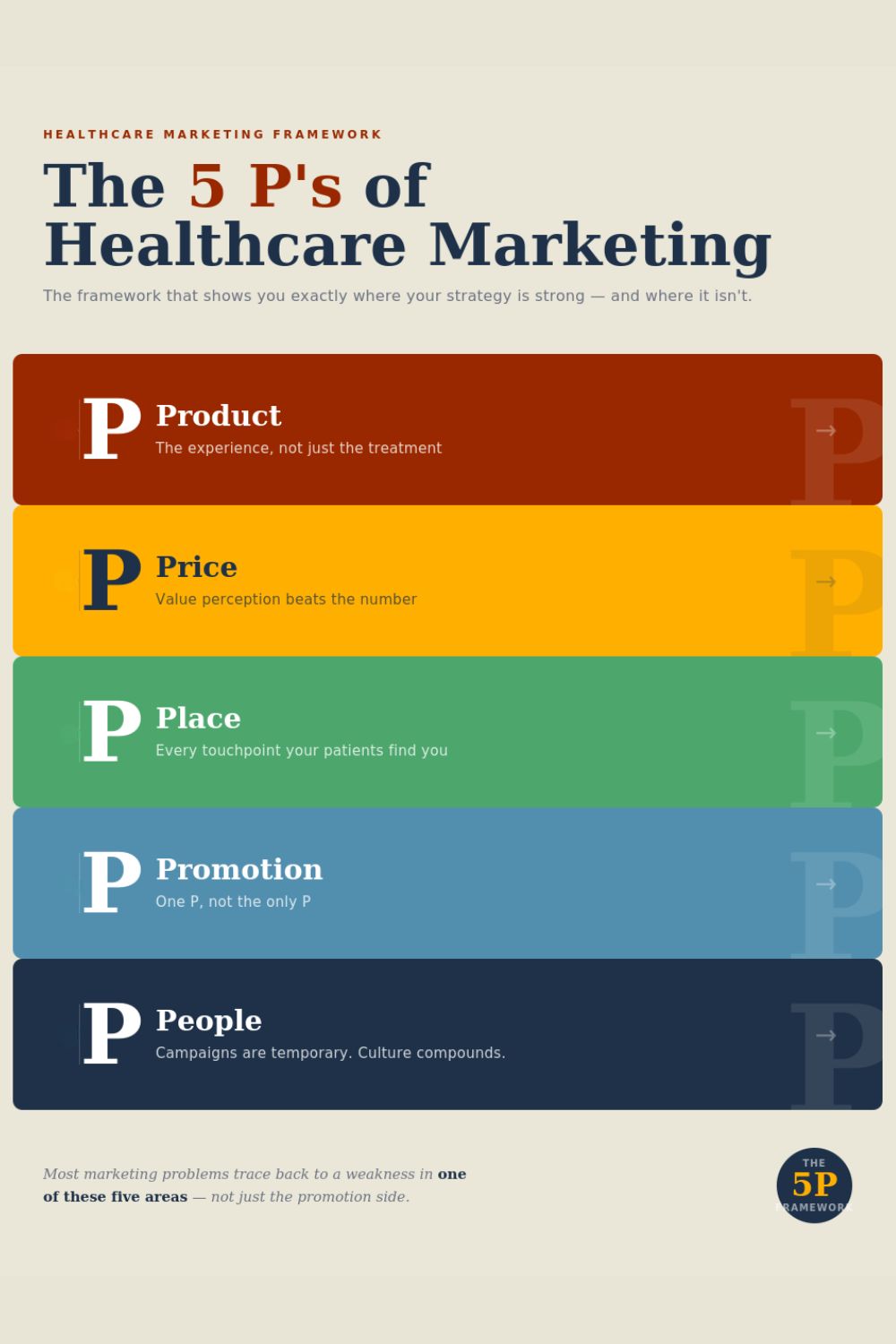
The 5 P’s of healthcare marketing are Product, Price, Place, Promotion, and People. They’re a framework borrowed from traditional marketing but they translate surprisingly well to healthcare — and when you apply them intentionally, they give you a much clearer picture of where your strategy is strong and where it has gaps.
Product — What You’re Actually Offering
In healthcare, your product is your service. But it goes deeper than the treatment or the consultation itself. It’s the experience around it. The ease of booking, the environment, the follow-up care, the way your staff communicates. Patients aren’t just buying a procedure — they’re buying an outcome and an experience. If either falls short, no amount of marketing will fix it.
Price — Value Perception Matters More Than the Number
Pricing in healthcare is sensitive and complex. But from a marketing perspective, the bigger issue is often value perception. Are you communicating clearly what someone gets for their investment? Private healthcare, wellness coaching, and premium health products all require you to justify the price through trust and demonstrated results — not just list it and hope for the best.
Place — Where and How People Access You
Place used to mean location. Now it means every touchpoint someone has with your brand — your website, your Google Business Profile, your social channels, your booking system. For location-based clinics, local SEO is your version of “place.” For digital-first health brands, it’s about being present on the platforms where your audience already spends time.
Promotion — Getting Your Message Out
This is what most people think of when they hear “marketing.” Ads, content, email, social media, SEO. Promotion is important, but it’s only one of five P’s — and it only works well when the other four are solid. Promoting a service with a poor patient experience, confusing pricing, or no clear positioning is expensive and ineffective.
People — Your Most Underrated Marketing Asset
This one doesn’t get enough attention. The people inside your organisation — your clinicians, your front desk team, your coaches — are part of your marketing whether you realise it or not. Every interaction a patient or client has with your team either builds trust or erodes it. Invest in your people, and your marketing results will follow. Campaigns are temporary. Culture compounds.
Healthcare Marketing Strategies That Work in 2026
Healthcare marketing has never been more competitive. More practitioners are online, more patients are researching before they book, and more health brands are fighting for the same attention. The strategies below aren’t trends — they’re the fundamentals that consistently drive real growth when executed properly.
Local SEO and Google Business Profile
For location-based clinics and private practitioners, local SEO is non-negotiable. When someone searches “physiotherapist in Manchester” or “private GP near me,” Google serves results based on proximity, relevance, and trust signals. If you’re not optimised for local search, you’re invisible to the people closest to you — the ones most likely to book.
Start with your Google Business Profile. Keep it fully completed, updated, and stacked with genuine patient reviews. Research shows that businesses with complete profiles are significantly more likely to attract patient visits — and that 59% of patients use online search to find a new primary care provider. Then make sure your website includes location-specific pages, your NAP (name, address, phone number) is consistent across every directory, and your content targets the treatment and location keywords your ideal patients are actually searching.
Local SEO isn’t glamorous but the compounding effect is real. A clinic we worked with saw a 50% increase in organic traffic and a 400% increase in page one keyword rankings within four months of implementing a focused local SEO strategy alongside a website redesign. That’s what happens when you stop guessing and start targeting with precision.
Content Marketing and Patient Education
The practitioners and health brands winning online right now are the ones giving away their best knowledge for free. Not watered-down tips — genuinely useful, specific content that helps people even before they become a patient or client.
This builds trust faster than any ad. When someone finds your blog post, watches your video, or reads your FAQ and thinks “this person actually knows what they’re talking about” — you’ve already won half the battle. They come to you pre-sold.
The data backs this up: providers with patient education content see 34% higher retention rates, and educational posts earn over twice the engagement of purely promotional content. Content marketing works best when it’s built around the questions your audience is already asking. Use Google’s People Also Ask, your own patient FAQs, and keyword research to build a content library that captures search traffic and establishes authority over time. Blog posts, video content, downloadable guides — all of it compounds. Unlike paid ads, good content keeps working long after you’ve published it.
Social Media for Health and Wellness Professionals
Social media for healthcare isn’t about going viral. It’s about showing up consistently for the people who need what you offer. Frequency matters more than most practitioners realise — on average, people need to see you 14 times or more before making a decision to book. That means sporadic posting won’t cut it.
The platforms worth your time depend on your audience. Instagram and TikTok work well for wellness coaches, therapists, and health brands targeting consumers. LinkedIn is underutilised but powerful for health tech, B2B health brands, and practitioners targeting corporate wellness. Facebook still drives results for local clinics targeting an older demographic.
What works across all of them: share your honest opinions, show your personality, and don’t blend in. Healthcare is full of safe, sanitised content. The practitioners who stand out are the ones willing to say something real — to challenge assumptions, share a perspective, and connect like an actual human being rather than a brochure.
And always — always — end with a call to action. Great content that doesn’t tell people what to do next is just entertainment.
Email Marketing and Patient Retention
Most healthcare marketers obsess over acquisition and neglect retention. That’s an expensive mistake. The patients or clients already in your ecosystem are your warmest audience — they’ve already chosen you once. Email marketing is how you stay front of mind, nurture relationships, and drive repeat bookings without spending a penny on ads.
A simple email strategy for a clinic might include a welcome sequence for new patients, a monthly newsletter with genuinely useful health content, and targeted campaigns around seasonal services or new offerings. Healthcare email campaigns have an average open rate of around 41% — well above most other industries — which means your audience is genuinely receptive when the content is relevant and useful.
Keep it consistent, keep it valuable, and treat it like a conversation — not a broadcast.
Paid Advertising for Healthcare (Google & Meta)
Paid advertising works in healthcare when it’s targeted correctly and the landing page experience matches the promise of the ad. Too many clinics and practitioners run ads that drive traffic to a generic homepage and wonder why nothing converts. The ad is just the beginning — what happens after the click is what determines your return.
Google Search ads are powerful for high-intent queries — someone searching “back pain specialist London” is ready to book. Performance Max campaigns can extend your reach across Google’s full network when set up properly. Meta ads work better for awareness and nurturing — reaching people who don’t know they need you yet.
Brand and performance marketing are not rivals. The practices that scale sustainably run both — building brand awareness over time while driving direct conversions through performance campaigns. Treating them as an either/or is one of the most common and costly mistakes in healthcare marketing.
One important note: healthcare advertising on Meta and Google comes with platform-specific restrictions around medical claims and sensitive health topics. Understanding the compliance rules before you spend isn’t optional — violations can result in account suspensions and significant fines.
Influencer and Community Marketing for Health Brands
For supplement companies, health tech brands, and wellness products, influencer marketing has shifted. The era of paying a celebrity to hold your product is largely over. What works now is credibility — partnerships with practitioners, researchers, coaches, and community figures who have genuine authority in their niche and an audience that trusts them.
Micro-influencers with smaller but highly engaged, niche audiences consistently outperform broad reach partnerships in healthcare. Someone with 8,000 highly engaged followers in the fitness and rehab space will drive more qualified action than someone with 500,000 general wellness followers who posts everything from protein shakes to holidays.
The same principle applies to community marketing — building or participating in spaces where your audience already gathers. Online communities, professional networks, and events where trust is already established are some of the most underrated growth channels in the health space.
Healthcare Marketing Tips for Doctors and Medical Professionals
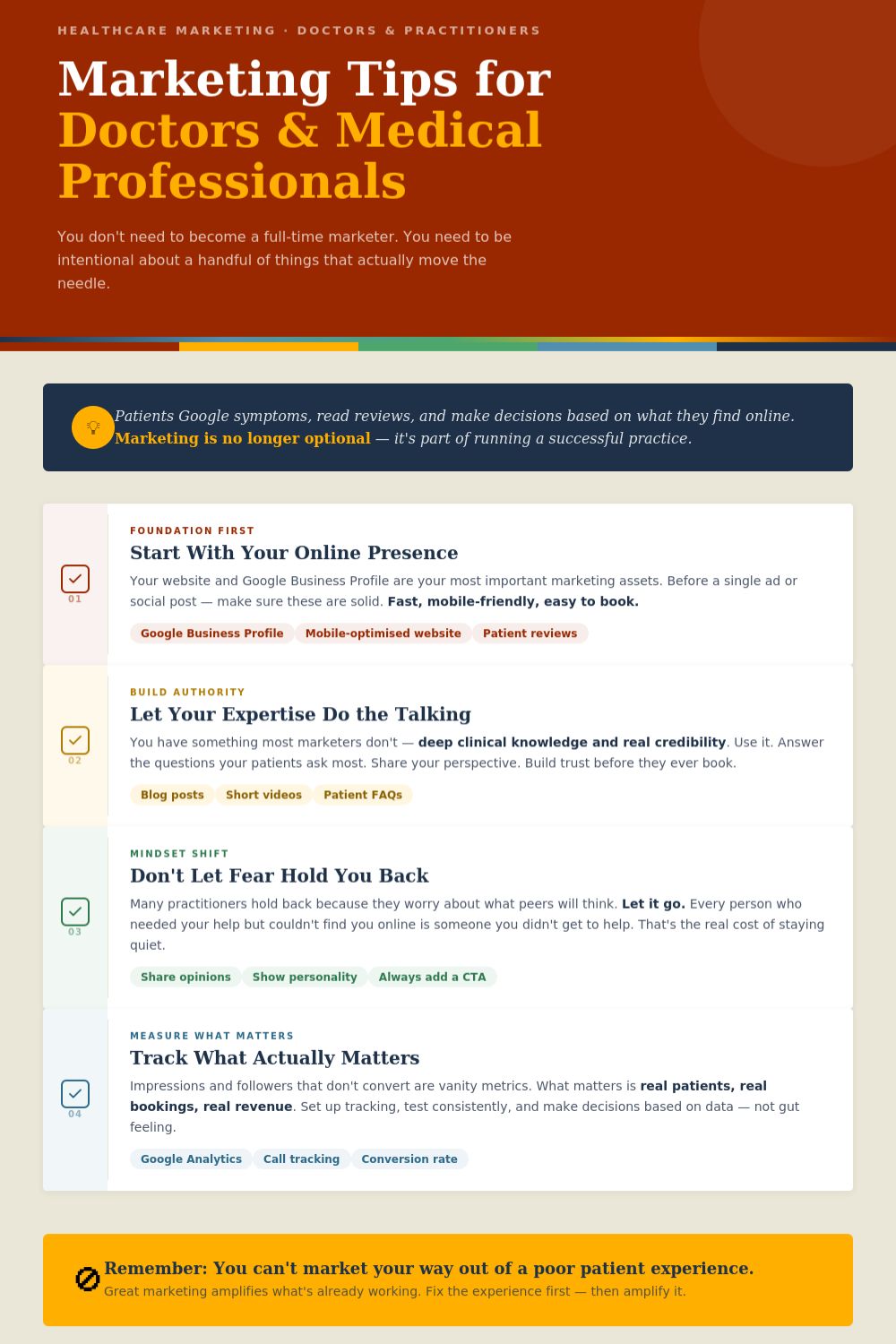
Most doctors and medical professionals didn’t go through years of training to become marketers. But in a world where patients Google their symptoms, read reviews before booking, and make decisions based on what they find online — marketing is no longer optional. It’s part of running a successful practice.
The good news is you don’t need to become a full-time content creator or ad strategist. You need to be intentional about a handful of things that actually move the needle.
Start With Your Online Presence
Your website and Google Business Profile are your most important marketing assets. Before you run a single ad or post on social media, make sure these are in order. Your website should load fast, work on mobile, clearly explain what you do and who you help, and make it easy to book. Your Google Business Profile should be fully completed with up to date information, photos, and a steady stream of genuine patient reviews.
This is your foundation. Everything else builds on top of it.
Let Your Expertise Do the Talking
You have something most marketers don’t — deep clinical knowledge and real credibility. Use it. Write a blog post answering the questions your patients ask most. Record a short video explaining a common condition or misconception. Share your perspective on a topic in your field.
You don’t need to share everything. You just need to share enough that when someone finds your content, they think — this person knows what they’re talking about. That’s the moment trust begins. And trust is what converts a searcher into a patient.
Don’t Let Fear Hold You Back
This one comes up more than you’d think. Many healthcare professionals hold back from marketing because they’re worried about what peers will think, whether they’ll say something wrong, or whether promoting themselves feels somehow unprofessional.
Let it go. Marketing your practice isn’t vanity — it’s how you help more people. Every person who needed your expertise but couldn’t find you because you weren’t visible online is someone you didn’t get to help. That’s the real cost of staying quiet.
Track What Actually Matters
Marketing qualified leads that don’t convert are vanity metrics. Impressions that don’t lead to bookings are vanity metrics. What matters is whether your marketing is generating real patients, real consultations, real revenue.
Set up basic tracking — Google Analytics on your website, call tracking if you run ads, a simple system for asking new patients how they found you. You don’t need a sophisticated MarTech stack to start. You need enough data to know what’s working and what isn’t. Test, measure, adjust. Your gut feelings won’t pay the bills. Results will.
What Successful Healthcare Marketing Actually Looks Like
Strategy is only as good as its results. It’s easy to talk about SEO, content, and paid ads in the abstract — but what does it actually look like when a healthcare marketing strategy comes together properly?
Here’s a real example.
Case Study — Medspa Clinic
REVIV is a pioneer in evidence-based IV drip therapies and vitamin shots for wellness, performance, and anti-ageing. When they came to us, the problem wasn’t awareness — their ideal patients were already searching for their treatments on Google. The problem was their Google Ads weren’t converting efficiently. High spend, low return, and a campaign structure that had become too complex to optimise properly.
The issues were clear from the audit: cost per conversion was sitting at HKD $150, budgets were spread too thin across too many campaigns, and Performance Max — one of the most powerful growth channels available — was barely being used.
The strategy had five components:
A simplified campaign structure — one campaign per core product, each running only one to two high-performing ads. Channel optimization that tested both Search and Performance Max, with Performance Max becoming the primary growth driver. Stronger budget allocation to give campaigns enough data to learn before scaling. Systematic testing of ads, headlines, keywords, and creatives. And landing page fixes — including broken booking links that were quietly killing conversions.
No guesswork. No gut feelings. Just a structured approach built around data and a clear goal.
Here’s what happened:
Over the full campaign period, conversions more than doubled — from 166 to 355 — on virtually the same budget (HKD $25,900 vs $25,300). Cost per conversion dropped from HKD $156 to HKD $71. That’s a 54% reduction in acquisition cost while simultaneously increasing conversion volume.
Then the momentum continued. In the most recent 30-day window, cost per conversion had dropped further to HKD $52.50 — down from the original HKD $150. In one standout week, the campaigns delivered 90 conversions at an average of just HKD $36.99 each. Month-over-month, conversions grew 10x from September through to January.
What This Case Study Actually Teaches Us
The REVIV results didn’t come from one clever ad or a lucky month. They came from a methodical process — audit, simplify, test, optimise, scale. The kind of work that isn’t glamorous but compounds over time.
This is what effective paid media looks like in healthcare. Not throwing budget at campaigns and hoping for the best. Not running ten products in one campaign and wondering why nothing converts. It’s knowing exactly where your money is going, testing consistently, and doubling down on what works.
If your Google Ads feel expensive and your results feel flat — the problem usually isn’t the platform. It’s the structure, the targeting, or the post-click experience. Fix those, and the numbers follow.
Frequently Asked Questions
What is marketing in healthcare?
Healthcare marketing is the process of connecting your services to the people who need them through strategic messaging, digital presence, and consistent communication. It covers everything from your website and SEO to social media, paid ads, and patient retention — with the goal of building trust and driving sustainable growth.
What are the 5 P’s of healthcare marketing?
The 5 P’s of healthcare marketing are Product, Price, Place, Promotion, and People. Each one plays a role in how your practice or health brand is positioned and perceived. Most marketing problems can be traced back to a weakness in one of these five areas — not just the promotion side.
What are some effective healthcare marketing strategies?
The strategies that consistently deliver results are local SEO, content marketing, social media, email marketing, and paid advertising — but only when they work together as part of a joined-up strategy. Isolated tactics rarely move the needle. A holistic approach that aligns your channels, messaging, and audience targeting is what drives real growth.
What is an example of successful healthcare marketing?
Scoliosis SOS Clinic is a strong example. Through a combination of website redesign, targeted SEO, and strategic PPC campaigns, the clinic achieved a 400% increase in page one keyword rankings, 50% growth in organic traffic, and 234 high-quality conversions in just four months. The results came from strategy and execution working together — not one single tactic.
Do healthcare professionals really need to market themselves?
Yes — and the cost of not doing it is higher than most realise. Patients research online before booking, compare options, and make decisions based on what they find. If you’re not visible, you’re not in the conversation. Marketing your practice isn’t about self-promotion — it’s about making sure the people who need your help can actually find you.
How do I know if my healthcare marketing is working?
Track the metrics that tie directly to business outcomes — new patient enquiries, consultation bookings, conversion rates, and cost per acquisition. Impressions and follower counts tell you very little on their own. Set up proper tracking from the start, test consistently, and make decisions based on data rather than gut feeling.
Sources and References
- HHS — HIPAA Marketing Guidelines
- Google Business Profile Optimization for Healthcare — CareCredit
- Google Business Profile Healthcare Case Study — Defiance Analytics
- 92+ Healthcare Marketing Statistics 2025 — Marketing LTB
- 37 Healthcare Marketing Statistics — Digital Silk
- 2025 Healthcare Marketing Benchmarks — Inner Spark Creative
- HIPAA Compliant Marketing in 2025 — Evolve
- Google Analytics
- Local Falcon — Google Business Profile for Healthcare Practices

Leave A Comment